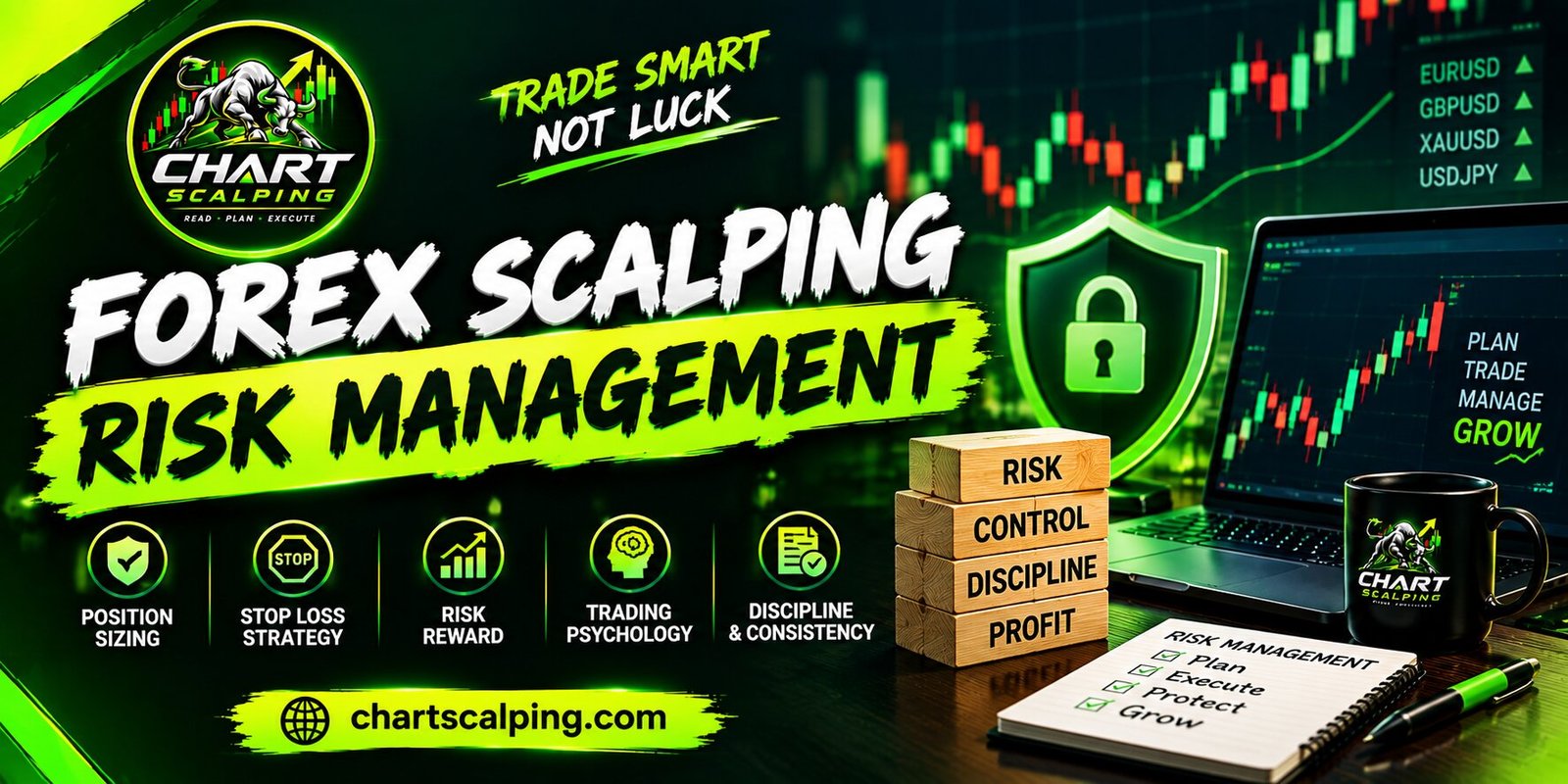
Scalping is a trading style where small price movements are targeted over relatively short periods. Because scalpers may take multiple trades, risk management becomes one of the most important parts of the entire trading process.
A profitable setup can still become a poor trading decision if the position is too large, the stop loss is badly placed or the trader continues trading after reaching a daily loss limit.
Professional risk management is therefore not about avoiding losses completely. Losses are a normal part of trading. The objective is to make sure that individual losses remain controlled and that no single trade can seriously damage the trading account.
This lesson explains how to build a structured risk management framework for forex scalping.
1. What Is Risk Management?
Risk management is the process of controlling how much capital is exposed to loss during trading.
It includes decisions such as:
- How much to risk per trade
- Where to place the stop loss
- How large the position should be
- How much to lose in one trading day
- How much drawdown is acceptable
- When to stop trading
- How to handle losing streaks
A strategy determines when you want to trade. Risk management determines how much you are willing to lose when that idea is wrong.
Strategy finds the opportunity. Risk management protects the capital.
2. Why Scalpers Need Strict Risk Control
Scalping creates a unique risk environment. Because trades are short-term, traders may be tempted to take many setups during a single session.
This can create a dangerous cycle:
The solution is to define risk before the trading session begins.
Scalping Risk Should Be Controlled At Three Levels
- Trade Level: Risk on one position
- Daily Level: Maximum daily loss
- Account Level: Maximum acceptable drawdown
3. Decide Your Risk Per Trade
One of the first decisions a trader should make is how much of the account can be lost if one trade reaches its stop loss.
Many traders use a percentage of account equity rather than a fixed lot size.
Example
Risk Per Trade: 0.5%
Maximum Planned Loss: $50
The advantage of percentage-based risk is that position size can change as the account changes while the percentage exposure remains consistent.
4. Calculate Your Monetary Risk
Before entering a trade, convert your chosen risk percentage into an actual monetary amount.
Basic Formula
Example 1
Account = $5,000
Risk = 0.5%
Example 2
Account = $20,000
Risk = 0.5%
Once the maximum monetary risk is known, position size can be calculated according to the stop-loss distance and instrument specifications.
5. Position Sizing
Position sizing determines how large your trade should be.
A common mistake is choosing the lot size first and then placing a stop loss around it.
A more structured process is:
This means the stop loss determines the required position size rather than the desired lot size determining the stop.
Example Concept
Suppose two setups both have a maximum risk of $50.
Setup A has a relatively small stop distance.
Setup B has a larger stop distance.
The correct position sizes will therefore be different even though the maximum dollar risk remains approximately the same.
6. Stop Loss Placement
A stop loss should represent the point where the original trading idea becomes invalid.
Poor Method
“I always use the same number of points.”
Better Method
“I place the stop beyond the structure that invalidates my setup.”
Depending on the strategy, invalidation may be related to:
- Swing high
- Swing low
- Liquidity sweep
- Market structure
- Support or resistance
- Volatility conditions
7. Risk-to-Reward Ratio
Risk-to-reward compares the amount you are willing to lose with the amount you plan to gain.
1:2 Example
Potential Reward = $100
R:R = 1:2
1:3 Example
Potential Reward = $150
R:R = 1:3
A higher R:R does not automatically mean a better strategy. A larger target may reduce the probability of reaching it.
The correct R:R should be based on the actual characteristics and backtested performance of the strategy.
8. Set a Daily Loss Limit
Per-trade risk alone is not enough.
A scalper can lose money through a series of individually acceptable trades.
For example:
Trade 2 = -0.5%
Trade 3 = -0.5%
Trade 4 = -0.5%
Trade 5 = -0.5%
Total = -2.5%
A predefined daily loss limit can prevent emotional attempts to recover losses.
Example Rule
Once reached: Stop trading for the day.
The exact limit should match the trader's strategy, account structure and risk plan.
9. Drawdown Management
Drawdown is the decline in account value from a previous equity high.
For example:
Current Equity: $9,000
Drawdown: 10%
Large drawdowns require increasingly larger gains to recover.
Why Drawdown Matters
Losing 10% does not require a 10% gain to return to the original balance.
↓
-10%
↓
$9,000
Recovery required: +11.11%
Protecting the account is therefore often easier than recovering from a deep drawdown.
10. Managing Losing Streaks
Every trading strategy can experience losing streaks.
A losing streak does not automatically mean the strategy has failed.
Example
Risk per trade = 0.5%
Approximate loss = 2.5%
A controlled losing streak is very different from increasing risk after every loss.
Never Use Martingale to Recover Losses
Increasing position size after losses can rapidly magnify drawdown and expose the account to a potentially catastrophic loss.
A losing trade should change your emotions, not your risk rules.
11. Leverage & Margin
Leverage allows traders to control a larger position with a smaller amount of margin.
However, high available leverage does not mean that high position size is appropriate.
Risk should be determined by the stop loss, position size and predefined monetary risk, not by the maximum position your broker allows.
Margin Is Not the Same as Risk
Margin is the amount required to maintain a leveraged position. Actual trade risk depends on position size and the distance between entry and stop loss.
12. News & Execution Risk
Scalpers should understand that planned risk and actual realized loss are not always identical under all market conditions.
During major news or abnormal volatility, traders may experience:
- Wider spreads
- Slippage
- Rapid price movement
- Delayed execution
- Temporary liquidity changes
This is particularly important for instruments that can experience rapid price expansion.
13. Overtrading & Risk
Overtrading is one of the most common risk management failures among scalpers.
It can happen after:
- A losing trade
- A winning trade
- Missing a setup
- Boredom
- FOMO
- A desire to reach a daily target
More trades create more exposure. They do not automatically create more profit.
14. Risk Management Psychology
Risk management is partly mathematical and partly psychological.
A trader may know the correct risk percentage but abandon it after a loss.
Common Emotional Errors
- Increasing lot size after losses
- Moving stop loss
- Removing the stop loss
- Taking revenge trades
- Trading to recover money
- Taking oversized trades after winning
- Breaking daily loss limits
The best risk plan is useless if you do not follow it when emotions become strong.
The purpose of predefined rules is to reduce the number of decisions you must make under emotional pressure.
15. Build Your Personal Risk Rules
A scalper should have written rules before entering the market.
Example Risk Framework
Risk-to-Reward: 1:2 or 1:3
Maximum Trades: Predefined
Daily Loss Limit: Predefined
Stop Loss: Always defined before entry
Revenge Trading: Not allowed
Lot Size: Calculated from risk
These are examples rather than universal requirements. Your own rules should be based on your strategy and testing.
16. Keep a Risk Management Journal
A trading journal should record more than whether a trade won or lost.
Useful Risk Fields
- Account equity before trade
- Risk percentage
- Dollar risk
- Position size
- Stop-loss distance
- Target distance
- Planned R:R
- Actual result in R
- Maximum daily loss
- Number of trades
- Rule violations
- Emotional state
Over time, this information can reveal whether your biggest problems are strategy-related or execution-related.
17. Practical Scalping Risk Example
Consider a trader with a $10,000 account who chooses to risk 0.5% per trade.
Risk: 0.5%
Maximum Risk: $50
The trader identifies a setup with a clear invalidation point.
The stop-loss distance is measured and the position size is calculated so that a full stop-out represents approximately $50 of risk.
If the strategy targets 1:2 R:R:
Target = $100
Result:
Stop = -1R
Target = +2R
The important part is not the dollar amount. The important part is that the risk was defined before the trade was executed.
18. Common Forex Scalping Risk Mistakes
1. Choosing Lot Size First
Starting with a desired lot size can result in inconsistent risk.
2. Moving the Stop Loss
Moving a stop farther away increases the original planned risk.
3. Removing the Stop
Removing a predefined invalidation point can turn a controlled loss into an uncontrolled one.
4. Revenge Trading
Attempting to recover losses immediately often leads to oversized or low-quality trades.
5. Ignoring Daily Limits
Continuing to trade after reaching your predefined daily loss limit destroys the purpose of having that rule.
6. Increasing Risk After Winning
A winning streak does not guarantee that the next trade will win.
7. Using Maximum Leverage
Broker-provided leverage is a facility, not a target for position size.
8. Risking Too Much on One Setup
No individual setup should have the power to seriously damage the account.
19. Forex Scalping Risk Checklist
Before entering a trade, ask:
- ✓ What is my risk percentage?
- ✓ What is my maximum dollar risk?
- ✓ Where is the trade invalidated?
- ✓ Is the stop loss clearly defined?
- ✓ Have I calculated the correct position size?
- ✓ What is my planned R:R?
- ✓ Is the target realistic?
- ✓ How much have I already risked today?
- ✓ Have I reached my daily loss limit?
- ✓ Is major news approaching?
- ✓ Am I taking this trade because of my plan?
- ✓ Am I trying to recover a previous loss?
- ✓ Am I increasing size emotionally?
20. Risk Management Learning Roadmap
Step 1 — Understand Risk
Learn the difference between account balance, equity, margin and monetary risk.
Step 2 — Define Risk Per Trade
Choose a consistent risk framework.
Step 3 — Learn Position Sizing
Understand how stop distance affects position size.
Step 4 — Master Stop Loss
Place stops at genuine invalidation points.
Step 5 — Understand R:R
Study how risk-to-reward interacts with win rate and expectancy.
Step 6 — Create Daily Limits
Define when you stop trading for the day.
Step 7 — Study Drawdown
Learn how losing periods affect account recovery.
Step 8 — Journal Your Risk
Track whether you actually follow your rules.
Step 9 — Backtest
Test your strategy with the exact risk model you intend to use live.
Step 10 — Protect Consistency
Your objective is not to maximize the risk of every trade. It is to survive long enough for your trading edge to play out.
Final Thoughts
Risk management is the foundation that allows a trading strategy to survive.
Even a strong strategy can become dangerous when combined with oversized positions, uncontrolled leverage or emotional decision-making.
A disciplined scalper should know the risk before entering the market.
The objective is not to avoid every losing trade. That is impossible.
The objective is to make sure that losses remain small enough for the trading system to continue operating.
Protect your capital first. The next trading opportunity will always come.
Once risk becomes systematic, trading decisions can become less emotional and more process-driven.
Forex Scalping Risk Management — Quick Summary
- Define risk before every trade.
- Use a consistent risk-per-trade framework.
- Convert percentage risk into monetary risk.
- Place the stop at genuine invalidation.
- Calculate position size from risk.
- Do not choose lot size first.
- Use a tested R:R model.
- Set a daily loss limit.
- Monitor account drawdown.
- Never use martingale to recover losses.
- Do not remove or move stops emotionally.
- Respect news and execution risk.
- Control the number of trades.
- Keep a detailed trading journal.
- Review your risk rules regularly.
Continue Your Trading Education
Learn more about scalping, market structure, price action, liquidity, execution and trading psychology through ChartScalping Academy.
Explore Academy