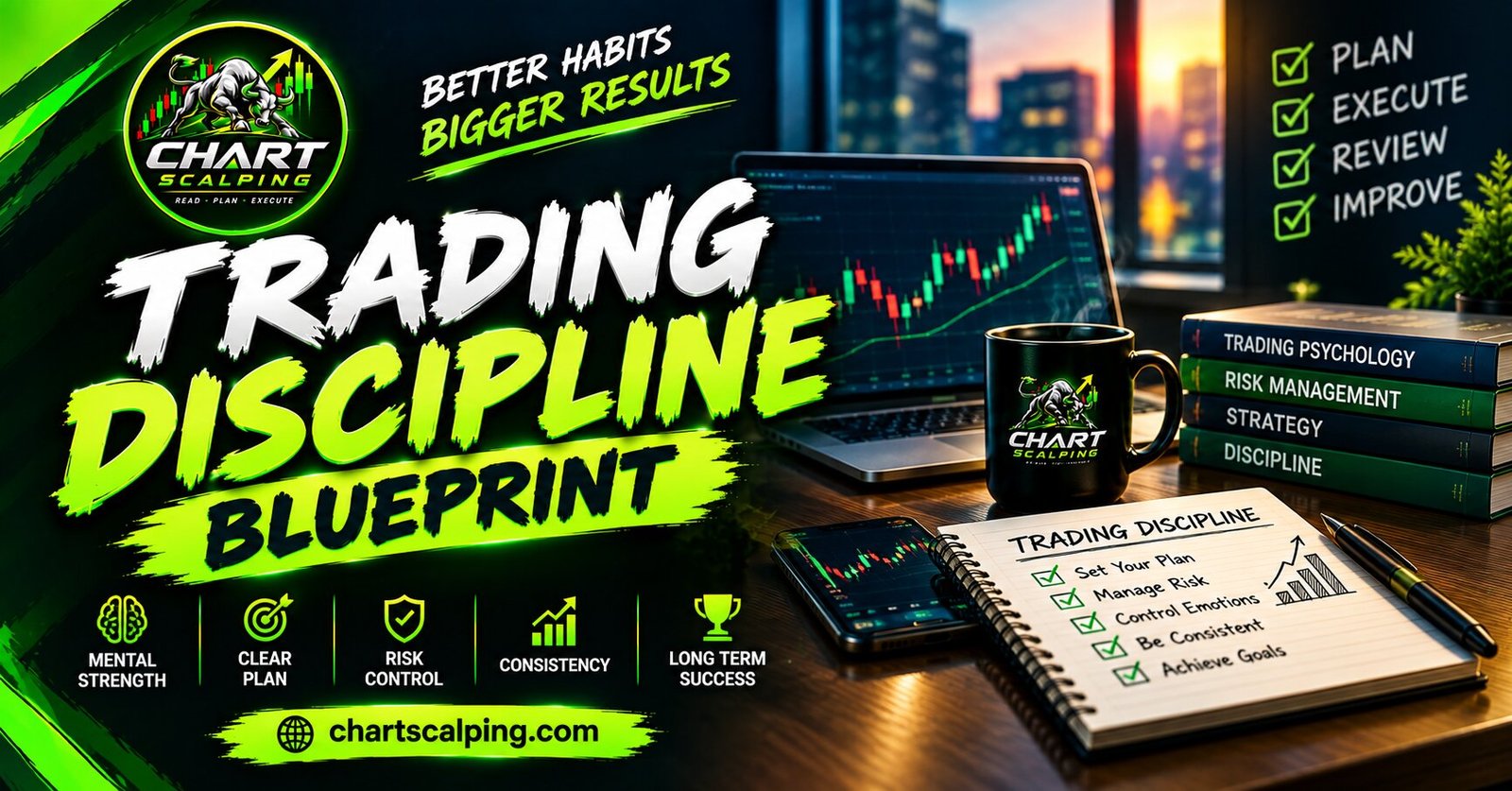
Trading discipline is the ability to follow your trading process even when emotions, market noise or recent results encourage you to do something different.
A trader may have a good strategy, excellent technical knowledge and access to powerful trading tools, but none of these guarantees consistent execution.
The real challenge often begins after the trading plan meets the live market.
Price moves quickly. A setup is missed. A trade loses. Another trader posts a large profit online. The market suddenly moves without you.
These situations test discipline.
This guide provides a practical blueprint for building a repeatable trading process that reduces emotional decision-making and keeps execution aligned with your strategy.
1. What Is Trading Discipline?
Trading discipline means consistently following predefined rules regardless of whether the previous trade was a winner or a loser.
Discipline can involve:
- Waiting for your setup
- Following your risk rules
- Using the planned stop loss
- Avoiding unnecessary trades
- Respecting daily limits
- Following your trading session
- Recording your trades
- Reviewing mistakes honestly
Discipline is doing what your plan says even when your emotions want something else.
2. Why Trading Discipline Matters
Markets are uncertain. No trader can know the outcome of the next trade with certainty.
Because individual outcomes are uncertain, traders need to focus on what they can control.
The next candle
The next news event
Whether your setup wins
Short-term market volatility
You can control:
Your risk
Your position size
Your entry rules
Your stop loss
Your number of trades
Your behavior
Discipline focuses your attention on the second group.
3. Build a Trading Plan
Discipline becomes much easier when the rules are written before the market opens.
A trading plan should define:
- What instruments you trade
- Which sessions you trade
- Which timeframes you use
- What qualifies as a setup
- Where you enter
- Where your stop goes
- How targets are determined
- How much you risk
- When you stop trading
4. Create Non-Negotiable Rules
Not every trading decision should be flexible.
Some rules should become non-negotiable.
Example
Rule 2: Never increase risk to recover a loss.
Rule 3: Do not trade outside the tested session.
Rule 4: Stop trading after reaching the daily loss limit.
Rule 5: Do not chase missed trades.
Rules become useful when they are specific enough to remove ambiguity.
5. Build a Trading Routine
A consistent routine reduces impulsive decision-making.
Before Trading
- Check the economic calendar
- Review your trading plan
- Mark important levels
- Identify market structure
- Define your session
- Confirm maximum daily risk
During Trading
- Wait for the setup
- Confirm entry conditions
- Calculate risk
- Execute according to plan
- Avoid unnecessary chart watching
After Trading
- Record the trade
- Save the chart screenshot
- Record the result in R
- Note emotional behavior
- Identify rule violations
6. Trade Only Your Setup
One of the strongest forms of discipline is learning to say:
“This is not my setup.”
The market can produce hundreds of price movements during a trading day. You do not need to participate in all of them.
Define exactly what your setup looks like.
Market Context
↓
Liquidity
↓
Sweep
↓
Confirmation
↓
Entry
↓
Defined Risk
If one of the critical conditions is missing, waiting may be the more disciplined decision.
7. Master Patience
Patience is not simply waiting for a trade. It is waiting for the right conditions.
Many traders feel uncomfortable when there is no position open.
They begin looking for reasons to enter.
Staying out of the market can be a successful execution of your trading plan.
Your objective is not to maximize the number of trades. It is to maximize the quality of the decisions you actually make.
8. Control FOMO
FOMO means Fear of Missing Out.
It commonly appears when price suddenly moves strongly without giving your planned entry.
The FOMO Cycle
The solution is simple but difficult:
A missed trade is better than an unplanned trade.
The market will provide another opportunity. Your job is to wait for one that matches your rules.
9. Avoid Revenge Trading
Revenge trading occurs when a trader attempts to recover a previous loss through emotional or oversized trades.
A common sequence looks like:
The correct response to a loss is not to immediately make the money back.
The correct response is to return to the plan.
10. Stop Overtrading
Overtrading means taking more trades than your strategy or plan justifies.
It can happen because of:
- Boredom
- FOMO
- Revenge
- Excitement after a winning trade
- Trying to reach a daily profit target
- Trying to recover a daily loss
More trades do not automatically create more opportunity. They create more exposure.
11. Accept Losing Trades
Losses are part of trading.
A valid setup can lose even when it is executed perfectly.
This distinction is important:
The setup followed the plan, but the outcome was negative.
Bad Trade + Win
The trader broke the rules, but the outcome happened to be positive.
A single result does not always tell you whether the decision was good.
Judge the quality of the decision, not only the outcome.
12. Control Winning Streaks
Discipline is also tested after winning.
Several consecutive winners can create overconfidence.
A trader may start thinking:
“The next trade will probably win too.”
“I can increase my lot size.”
This can turn a good trading session into an unnecessary risk event.
A winning streak does not remove uncertainty from the next trade.
13. Discipline & Risk Management
Risk management and discipline are closely connected.
A risk rule has no value if it is ignored during emotional situations.
Example Risk Framework
Risk-to-reward: Tested model
Maximum daily loss: Predefined
Maximum trades: Predefined
Stop loss: Required
Revenge trading: Not allowed
These are examples of a structured framework, not universal requirements. Your risk rules should match your strategy and account.
14. Execution Discipline
Having a trading plan is not enough. You must execute it consistently.
Before Entry
- Is this my setup?
- Is market context clear?
- Is the entry location valid?
- Is the stop defined?
- Is the risk acceptable?
- Is the target defined?
After Entry
- Do not widen the stop emotionally.
- Do not increase the position impulsively.
- Do not close early simply because you become nervous.
- Follow the predefined management plan.
Good execution means allowing the strategy to produce its statistical results over a sufficiently large sample.
15. Keep a Trading Journal
A trading journal is one of the most useful tools for developing discipline.
Record Every Trade
- Date
- Time
- Instrument
- Session
- Setup type
- Entry
- Stop loss
- Target
- Risk percentage
- Result in R
- Screenshot
- Emotional state
- Rule violations
Do not only record winning and losing trades. Record whether the trade followed the plan.
16. Daily & Weekly Review
Discipline improves through feedback.
Daily Review
At the end of the trading day, ask:
- Did I follow my setup?
- Did I respect my risk?
- Did I overtrade?
- Did I chase any trade?
- Did I move any stop?
- Did I follow my session rules?
Weekly Review
Review the larger pattern.
- Total trades
- Winning trades
- Losing trades
- Average R
- Rule violations
- Best setups
- Worst setups
- Emotional mistakes
17. Build Better Trading Habits
Discipline is not created through motivation alone.
It is built through repeated behavior.
Replace Bad Habits
Checking charts constantly
Practice:
Checking charts only during your planned trading window.
Instead of:
Entering because price is moving
Practice:
Waiting for your setup.
Instead of:
Increasing size after a loss
Practice:
Returning to the same risk model.
Small repeated behaviors eventually become part of your trading identity.
18. Common Trading Discipline Failures
1. Trading Without a Plan
Without predefined rules, decisions become reactive.
2. Changing Strategy Constantly
Switching systems after every losing period prevents meaningful testing.
3. Chasing Price
Entering after a large move because of FOMO often creates poor entries.
4. Revenge Trading
Attempting to recover a loss immediately can increase risk dramatically.
5. Overtrading
Taking low-quality trades simply because you are watching the market.
6. Moving Stop Loss
Changing the invalidation point after entry can destroy the original risk model.
7. Ignoring Daily Limits
Continuing after the daily risk limit has been reached turns a rule into a suggestion.
8. Trading While Emotionally Unstable
Strong frustration, excitement or anxiety can affect execution quality.
19. Trading Discipline Checklist
Before the session:
- ✓ Do I have a clear trading plan?
- ✓ Do I know my trading session?
- ✓ Do I know my maximum daily risk?
- ✓ Have I checked major economic events?
- ✓ Do I know what setup I am waiting for?
Before entering:
- ✓ Is this actually my setup?
- ✓ Is the market context clear?
- ✓ Is the entry valid?
- ✓ Is the stop defined?
- ✓ Is the risk acceptable?
- ✓ Is the target defined?
After a loss:
- ✓ Am I emotionally reacting?
- ✓ Am I trying to recover the loss?
- ✓ Am I increasing position size?
- ✓ Should I step away from the market?
20. Daily Trading Discipline Blueprint
Here is a simple daily framework that can turn discipline into a repeatable process.
Phase 1 — Prepare
↓
Mark important levels
↓
Identify market context
↓
Define trading session
↓
Confirm risk limits
Phase 2 — Wait
↓
Wait for your setup
↓
Wait for confirmation
Phase 3 — Execute
↓
Define Stop
↓
Calculate Risk
↓
Execute
Phase 4 — Manage
↓
Avoid emotional changes
↓
Accept the outcome
Phase 5 — Review
↓
Save screenshot
↓
Evaluate execution
↓
Identify lessons
21. Trading Discipline Roadmap
Step 1 — Define Your Strategy
Know exactly what qualifies as a trade.
Step 2 — Define Your Risk
Know exactly how much you are willing to lose before entering.
Step 3 — Create Your Rules
Write down your entry, exit and behavior rules.
Step 4 — Build Your Routine
Repeat the same preparation and review process.
Step 5 — Track Your Behavior
Journal not only your trades but also your rule violations.
Step 6 — Review the Data
Identify patterns in your execution.
Step 7 — Remove One Bad Habit at a Time
Do not attempt to change everything at once.
Step 8 — Repeat
Discipline develops through repetition.
Final Thoughts
Trading discipline is not about becoming emotionless.
Fear, excitement, frustration and uncertainty are normal human reactions to financial risk.
The goal is to build a process that prevents those emotions from controlling your decisions.
A disciplined trader does not need to predict every market movement.
The trader needs to execute a tested process consistently over a meaningful sample of trades.
You do not need more trades. You need better decisions.
Protect your capital, protect your attention, follow your rules and allow your strategy to produce its results over time.
Trading Discipline Blueprint — Quick Summary
- Build a written trading plan.
- Define your setup clearly.
- Create non-negotiable risk rules.
- Follow a consistent trading routine.
- Wait for your setup instead of forcing trades.
- Do not chase missed opportunities.
- Avoid revenge trading.
- Control overtrading.
- Accept losing trades as part of the process.
- Do not become overconfident after winning.
- Never increase risk emotionally.
- Keep a detailed trading journal.
- Review execution regularly.
- Improve one behavior at a time.
- Focus on consistency rather than excitement.
Continue Your Trading Education
Continue learning market structure, scalping, risk management, price action and trading psychology through ChartScalping Academy.
Explore Academy