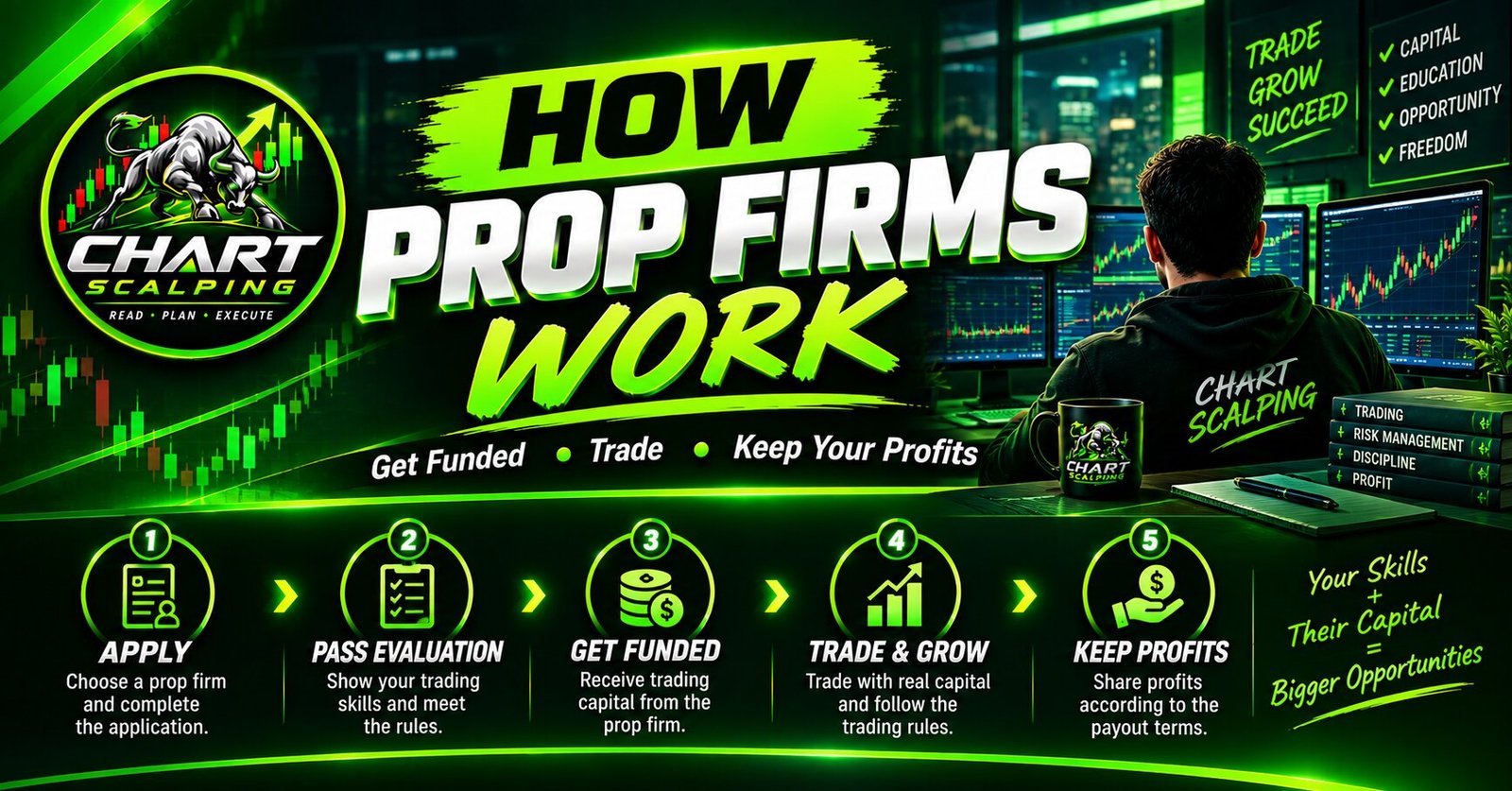
Proprietary trading firms, commonly called prop firms, have become increasingly popular among retail traders who want access to larger trading account programs without depositing a large amount of personal trading capital.
Instead of simply opening a traditional brokerage account, a trader may purchase or enter an evaluation program, follow a defined set of rules, and attempt to demonstrate consistent trading performance.
If the trader satisfies the firm's requirements, they may progress to a funded or funded-style account and become eligible for profit sharing according to the firm's terms.
However, prop trading is not simply "pay a small fee and receive a large account." Every firm has its own rules, risk limits, account structure, payout conditions and prohibited activities.
1. What Is a Prop Firm?
A proprietary trading firm is a company that provides traders with access to a trading program under specific rules and conditions.
In the traditional institutional model, proprietary traders trade a firm's capital and the firm takes financial risk alongside the trader.
Modern retail prop firms can operate differently. Some programs use simulated trading environments, while others may provide pathways to live or externally executed trading.
Therefore, the term "funded account" does not always mean that the trader receives a bank account containing the advertised account balance in cash.
2. How Prop Firms Make Money
Prop firms can have different business models, so there is no single model that applies to every company.
Depending on the firm and program, revenue may come from areas such as:
- Evaluation or challenge fees
- Subscription or recurring program fees
- Profit-sharing arrangements
- Trading-related revenue
- Other services or program fees
The exact business structure should be verified from the firm's current documentation.
3. The Prop Firm Evaluation Process
Many retail prop programs begin with an evaluation phase.
The trader selects an account size and attempts to meet a predefined set of performance and risk requirements.
A typical evaluation may include:
- Profit target
- Maximum daily loss
- Maximum overall drawdown
- Minimum trading days
- Consistency requirements
- Trading restrictions
Choose Program → Trade Under Rules → Meet Requirements → Verification / Next Stage → Funded or Funded-Style Account
4. Profit Targets
Some evaluation programs require the trader to reach a specific percentage profit target before progressing.
For example, a hypothetical program might require a trader to reach a predefined percentage gain while staying within all risk limits.
The important point is that reaching the profit target alone may not be enough.
The trader may also need to avoid:
- Daily loss violations
- Maximum drawdown violations
- Prohibited trading activity
- Other rule breaches
Make Profit
+
Protect the Account
5. Understanding Drawdown
Drawdown is one of the most important concepts in prop trading.
It represents a decline from a defined account reference point or equity level, depending on how the firm's rules calculate it.
A program may have:
- Maximum overall drawdown
- Static drawdown
- Trailing drawdown
- Equity-based drawdown
- Balance-based calculations
These definitions can be very different.
6. Daily Loss Limits
Many prop programs impose a maximum daily loss limit.
This means the trader cannot lose more than a defined amount during the firm's specified daily calculation period.
Depending on the program, the calculation may consider:
- Closed trades
- Floating losses
- Commissions
- Swaps or financing
- Starting balance or equity
7. Consistency Rules
Some prop programs use consistency rules to discourage traders from generating most of their performance from one unusually large trading day.
A consistency rule may examine:
- Largest profitable day
- Daily profit distribution
- Position size
- Trading frequency
- Other performance metrics
The exact formula varies between firms.
8. What Is a Funded Account?
After completing the required evaluation stages, a trader may progress to what the firm calls a funded account.
The exact structure differs between firms.
Some programs may provide a simulated account under a profit-sharing arrangement, while others may have different execution or capital-allocation structures.
The trader generally continues to operate under risk rules even after reaching the funded stage.
9. Simulated vs Live Trading
One of the most misunderstood parts of modern prop trading is the difference between simulated and live trading.
A trader may see an account balance such as $10,000, $50,000 or $100,000 on a platform. That number does not necessarily mean the trader has direct access to that amount of cash.
Some firms operate evaluation and funded-style programs primarily through simulated trading environments.
Other firms may use different models involving live execution, external allocation, or risk-based copying.
What exactly is the account?
How are trades executed?
Where does the capital come from?
How are profits calculated?
What happens after a payout request?
10. How Prop Firm Payouts Work
When a trader generates eligible profits, the firm may allow the trader to request a payout according to its rules.
Payout conditions can include:
- Minimum payout amount
- Minimum trading period
- Payout frequency
- Profit split
- Consistency requirements
- Verification requirements
- Rule compliance
Some programs may offer different payout schedules or profit-sharing structures.
11. Scaling Plans
Some prop firms offer scaling programs that increase the trader's account allocation or buying power after consistent performance.
A scaling plan may consider:
- Profit performance
- Number of payout cycles
- Risk consistency
- Account age
- Drawdown performance
Scaling rules are firm-specific, so traders should understand the exact requirements before building a long-term plan around them.
12. Common Prop Firm Rules
Before trading a prop account, carefully review every rule.
Common restrictions can include:
- Maximum daily loss
- Maximum overall drawdown
- Trailing drawdown
- Maximum lot size
- Maximum exposure
- Minimum trading days
- Consistency requirements
- News restrictions
- Weekend holding restrictions
- Overnight restrictions
- Copy trading restrictions
- Hedging restrictions
- Arbitrage restrictions
- Automated trading restrictions
13. Trading Strategies & Restrictions
Different prop firms may have different opinions and restrictions regarding trading strategies.
A program may permit strategies such as:
- Manual trading
- Scalping
- Swing trading
- Algorithmic trading
- Expert Advisors
But another firm may restrict one or more of these activities.
Strategies involving latency arbitrage, prohibited copying, exploitative execution behavior or other restricted activities may also be prohibited by some programs.
14. News Trading
News trading is another area where prop firm rules can differ significantly.
Some programs may allow traders to hold positions during major economic releases, while others may restrict opening or closing trades around specific events.
Important releases can include:
- CPI
- NFP
- FOMC decisions
- Interest-rate decisions
- Major employment data
- Other high-impact economic releases
15. Overnight & Weekend Rules
Traders who hold positions for longer periods must pay particular attention to overnight and weekend policies.
Some programs allow positions to remain open overnight and over weekends.
Others may require positions to be closed before a specified time.
This is particularly important for traders using swing strategies or holding positions around market closures.
Overnight Holding
Weekend Holding
Market Closure
Swap / Financing
Gap Risk
16. Prop Firm Risk Management
Risk management is arguably more important in a prop environment than the headline profit target.
A trader can have a profitable strategy and still lose an evaluation because position sizing is too aggressive.
Example
Personal Risk Model: 0.5% per trade
Planned Risk: $50
If a trader takes several trades in a day, the total planned exposure should also be considered.
Think in Risk Units
Instead of focusing only on dollar profit, traders can track results in R.
+2R = Two times your planned risk
-1R = One planned risk loss
This makes performance easier to compare across different account sizes.
17. Example of a Prop Firm Journey
Consider a hypothetical trader who selects a prop program.
Step 1 — Select a Program
The trader studies the account size, fee, drawdown, daily loss limit, payout policy and trading restrictions.
Step 2 — Build a Risk Plan
Before trading, the trader determines maximum risk per trade and maximum daily exposure.
Step 3 — Start the Evaluation
The trader follows the strategy while respecting every account rule.
Step 4 — Reach the Required Performance
The trader reaches the required target without violating risk rules.
Step 5 — Verification / Next Stage
If required, the trader completes the firm's verification or second stage.
Step 6 — Funded Stage
The trader continues using the same disciplined approach under the funded-stage rules.
Step 7 — Payout
When eligible, the trader requests a payout according to the firm's current conditions.
18. Why Traders Fail Prop Challenges
Many traders do not fail because their strategy has no edge. They fail because their risk management does not match the firm's rules.
1. Oversizing
A trader increases lot size to reach the target faster.
2. Revenge Trading
After a loss, the trader attempts to recover immediately with larger positions.
3. Overtrading
The trader takes setups that do not meet the strategy rules.
4. Ignoring Floating Loss
The trader focuses only on closed losses and forgets that floating losses may count toward a firm's drawdown calculation.
5. Chasing the Profit Target
The trader becomes impatient and increases risk because the target appears too far away.
6. Not Reading the Rules
A trader discovers a restriction only after violating it.
7. Changing Strategy
The trader abandons a tested setup after a few losing trades.
19. How to Choose a Prop Firm
Choosing a prop firm should not be based only on the cheapest challenge or the largest advertised account.
Compare the following:
- Company history and reputation
- Current program structure
- Evaluation fee
- Profit target
- Maximum daily loss
- Maximum overall drawdown
- Static vs trailing drawdown
- Profit split
- Payout conditions
- Minimum trading days
- News policy
- Weekend policy
- EA / algorithm policy
- Copy trading policy
- Maximum position size
- Scaling opportunities
- Supported platforms
- Payment and payout methods
- Customer support
20. Prop Firm Checklist
Before buying or starting any prop program, answer these questions:
- ✓ What is the exact account structure?
- ✓ Is the account simulated or live?
- ✓ What is the evaluation fee?
- ✓ What is the profit target?
- ✓ What is the daily loss limit?
- ✓ What is the maximum drawdown?
- ✓ Is the drawdown static or trailing?
- ✓ How is drawdown calculated?
- ✓ Does floating P&L count?
- ✓ Are there consistency rules?
- ✓ Are there minimum trading days?
- ✓ Is news trading allowed?
- ✓ Is weekend holding allowed?
- ✓ Are EAs allowed?
- ✓ Is copy trading allowed?
- ✓ Are hedging strategies allowed?
- ✓ What are the payout conditions?
- ✓ What is the profit split?
- ✓ How does scaling work?
- ✓ What happens after a rule violation?
21. Prop Trading Blueprint
A disciplined prop trader can structure the process like this:
Choose a Program
↓
STEP 2
Read Every Rule
↓
STEP 3
Build Risk Model
↓
STEP 4
Trade Only Tested Setups
↓
STEP 5
Protect Drawdown
↓
STEP 6
Reach Target Without Rushing
↓
STEP 7
Maintain Same Discipline
↓
STEP 8
Follow Payout Rules
↓
STEP 9
Scale Only When Appropriate
22. Common Prop Trading Mistakes
Mistake 1 — Treating the Account Size as Cash
The advertised account size is not necessarily the amount of cash you can freely lose.
Mistake 2 — Risking Too Much Per Trade
Large positions can quickly consume the available drawdown.
Mistake 3 — Focusing Only on the Profit Target
A target is only one part of the evaluation.
Mistake 4 — Ignoring Daily Reset Rules
Not understanding the firm's daily calculation period can lead to unexpected violations.
Mistake 5 — Trading Without a Daily Stop
A trader may continue trading after several losses and unnecessarily approach the firm's maximum loss limit.
Mistake 6 — Increasing Risk After Winning
Confidence can become overconfidence.
Mistake 7 — Buying Too Many Accounts
Multiple accounts can increase complexity and encourage excessive trading.
Mistake 8 — Not Checking Rule Changes
Program rules can change. Traders should review current terms rather than relying on old screenshots or social media posts.
23. Prop Trading Learning Roadmap
Step 1 — Learn Trading
Build a genuine trading process before worrying about prop firm evaluations.
Step 2 — Develop One Strategy
Define your setup, entry, stop, target and invalidation rules.
Step 3 — Backtest
Test the strategy across a meaningful historical sample.
Step 4 — Forward Test
Observe how the strategy behaves under current market conditions.
Step 5 — Build a Risk Model
Define risk per trade, daily loss limit and maximum exposure.
Step 6 — Study Prop Rules
Learn drawdown, daily loss, consistency, news, overnight and payout rules.
Step 7 — Choose Carefully
Select a program whose rules fit your trading style.
Step 8 — Trade Slowly
The objective should be controlled execution, not reaching the target as quickly as possible.
Step 9 — Protect the Account
Surviving drawdown is more important than maximizing short-term profit.
Final Thoughts
Prop firms can provide an alternative path for traders who want to trade under a structured risk framework without committing a large amount of personal capital to a traditional brokerage account.
But prop trading is not simply about passing a challenge.
The real challenge is building a trading process that can survive the firm's rules over time.
A trader should therefore study the rules before focusing on the profit target.
Understand the drawdown. Understand the daily loss calculation. Understand the payout conditions. Understand the trading restrictions. Understand how the account actually works.
The goal is not simply to pass a prop firm. The goal is to become consistent enough to operate within its rules.
When strategy, risk management and discipline work together, the prop firm becomes a framework rather than something that controls your trading decisions.
How Prop Firms Work — Quick Summary
- Prop firms provide structured trading programs.
- Many retail programs begin with an evaluation.
- Evaluations may include profit targets.
- Daily loss limits are common.
- Overall drawdown is one of the most important rules.
- Some programs use trailing drawdown.
- Some firms apply consistency requirements.
- "Funded" does not always mean direct access to the advertised cash balance.
- Trading may be simulated or live depending on the firm's model.
- Payout rules vary between firms.
- Profit splits vary between programs.
- News, overnight, weekend and EA rules can differ.
- Risk management is critical.
- The cheapest program is not necessarily the best program.
- Always read the current official rules.
Compare Prop Firms
Want to compare prop firm programs, account structures, trading rules, drawdown, payouts and other conditions? Explore the ChartScalping Prop Firms research section.
Explore Prop Firms